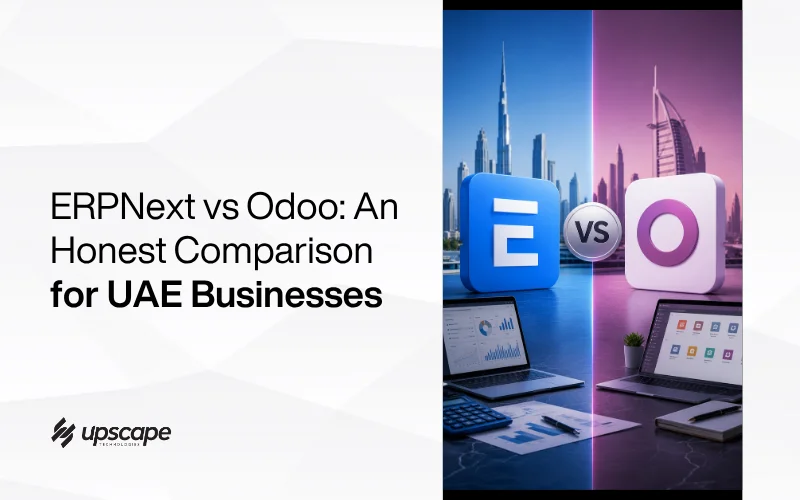

“They are both open source, so they are basically the same thing.”
That sentence has led plenty of UAE businesses into either paying more than they expected or discovering a feature they assumed was included sits behind a paid tier.
Both are genuinely capable systems. They are not the same deal, and the difference is not really about features. It is about what the free version actually contains.
Here is an honest comparison, including where Odoo is the better choice, because pretending otherwise would not help you decide.
The Core Difference in One Line
ERPNext puts everything in the open source version. Odoo puts some of it behind a paid tier.
That is the whole thing. Everything below is a consequence of it.
What ERPNext Includes
ERPNext ships every feature in its open source version with no proprietary tier, released under GPLv3. Accounting, HR, CRM, manufacturing, helpdesk and the rest all sit in the same core repository.
There is no upgrade path where features unlock, because there is nothing to unlock.
What Odoo Splits
Odoo Community is genuinely open source and genuinely free. The question is what it leaves out.
The gap between Community and Enterprise has widened in recent versions, with capabilities including advanced manufacturing, inter-company transactions, barcode scanning and Odoo Studio sitting in Enterprise as of Odoo 17 and 18.
None of that is hidden or dishonest. It is a normal open-core business model. It just means “Odoo is free” and “Odoo does what I need for free” are different statements.
What Does This Cost in Practice?
Direct answer: nothing for ERPNext licensing, and a recurring per-user fee for Odoo Enterprise.
Odoo Enterprise Pricing
Odoo Enterprise runs roughly $31.90 to $47.90 per user per month. For a 50-user business that is meaningful annual spend, and it recurs for as long as you use the system.
For a ten-person UAE SME the numbers are far smaller, which is worth saying plainly. The licence cost only becomes decisive as you add users.
The ERPNext Cost Shape
Self-hosted ERPNext carries no licence cost, leaving server expenses that typically run in the tens of dollars per month for a small deployment.
The money moves elsewhere: implementation, customisation and support. That is a real cost and not a small one, as our post on why ERP implementations fail covers in detail. But it is one-off and controllable rather than a recurring per-head charge.
Where Odoo Genuinely Wins
Any comparison that cannot name the other side’s strengths is marketing. Odoo is better at several things.
The Ecosystem Is Not Close
Odoo has over 40,000 community apps against roughly 1,000 for ERPNext, alongside more than 80 native modules.
This is the single strongest argument for Odoo. If your industry has a specific requirement and somebody has already built a module for it, Odoo probably has that module and ERPNext probably does not. Buying an existing app beats commissioning custom development almost every time.
Interface and Documentation
Odoo has materially better user experience, mobile apps and documentation.
That matters more than feature lists suggest. Adoption failures are usually about people not wanting to use the system, and a nicer interface genuinely helps. ERPNext has improved considerably but is still the plainer of the two.
Where ERPNext Wins
No Feature Wall
You are never told a capability requires an upgrade. For businesses that grow into needing multi-company handling or manufacturing, that removes an entire category of unpleasant surprise.
Customisation Without Forking
ERPNext is built on the Frappe Framework, with a form builder, workflow engine, role permissions and REST API, and the tight coupling between framework and application means significant customisation without forking the core.
In practice a competent Python developer can reshape ERPNext substantially. That cuts both ways: it is an advantage if you have or can hire that capability, and a liability if you cannot.
Odoo customisation frequently means either buying an app or writing a module, and Odoo Studio, its low-code customisation tool, sits in the Enterprise tier. That is a meaningful difference if adapting the system to your processes is central to the project.
Data and Exit
An underrated question: how easily could you leave? Both hold your data in a standard database you can access, which is a genuine advantage of open source over closed SaaS.
The practical difference is that ERPNext has one version to export from. With Odoo, a system built around Enterprise-only features is harder to move off, because the Community edition cannot simply take over.
Genuinely One Version
ERPNext is entirely open source with no enterprise edition holding features back. What you evaluate is what you get, which makes assessment simpler and removes the risk of building on something that later requires a licence.
Which Should a UAE Business Choose?
Direct answer: it turns on one question. Does a ready-made module already exist for your specific need?
Choose Odoo If
An existing app covers your industry closely, you have few users so per-seat pricing stays small, interface quality is a priority because adoption is your main risk, or you want a large partner network to choose from.
Choose ERPNext If
You need broad functionality without licence tiers, you expect to add users over time, you have or can access Python capability for customisation, or you want to avoid a recurring per-user cost that grows with headcount.
The UAE Angle
Two local considerations sit above the feature comparison.
Whichever you pick has to handle 5 percent VAT correctly and produce compliant tax invoices. Both can, with appropriate configuration, and neither does it perfectly out of the box for this market.
The second is support. A system nobody local can maintain is a risk regardless of which logo is on it. Ask who supports it here, what happens when your implementer is unavailable, and how easily you could move to another provider.
Odoo has the larger partner network globally and in this region, which is a real advantage. It also means partner quality varies widely, so the individual firm matters more than the badge.
Multi-Entity Structures
Worth flagging for UAE groups specifically. Businesses here commonly run several entities: a mainland company, a free zone company, sometimes more.
Multi-company consolidation is one of the capabilities that sits in Odoo Enterprise rather than Community, so a group structure that seems to fit the free edition may not once consolidated reporting is needed. ERPNext handles multiple companies in its standard version.
If your business is one legal entity, this is irrelevant. If it is three, it may decide the whole question.
What Neither Choice Fixes
Worth stating plainly: the software is rarely why ERP projects fail.
Whichever you choose, the project still lives or dies on whether the processes were mapped, the data was cleaned, and the people were trained. Our post on data migration and why timelines double applies identically to both systems.
Choosing the better-fitting platform helps. It does not rescue a badly run implementation.
How to Actually Compare Them
Feature tables are close to useless, because both systems tick nearly every box at that level of detail. Two things tell you more.
Demo your own processes, not theirs. Ask each partner to show your actual workflow: your quotation, your stock movement, your invoice with correct VAT. A polished generic demo proves nothing about whether the system fits how you work.
Cost it over three years, not one. Include licences at your expected headcount, implementation, customisation and support for all three years. Odoo often looks cheaper in year one and different by year three, and ERPNext’s zero licence fee means little if the customisation bill is large.
Run both through the same exercise. Whichever wins, you will have made the decision on your own numbers rather than on a comparison article, including this one.
The Bottom Line
Both are real, capable, open source systems used by serious businesses. The decision is not about which is better in the abstract.
Odoo wins on ecosystem and polish. ERPNext wins on having no feature wall and no per-user licence. If an off-the-shelf app solves your exact problem, that is worth a great deal. If not, paying per user for features ERPNext includes as standard is worth questioning.
If you want a straight assessment of which suits your operation, including being told when Odoo is the better fit, Fadil offers a free consultation with a live demo. You can watch ERPNext handle your actual workflows and judge the fit yourself rather than taking anyone’s word for it.
WhatsApp Fadil or call +971 56 544 6259. You can also see the work we have delivered or read what our ERPNext service includes.
Anyone who tells you one is simply better than the other is selling one of them.