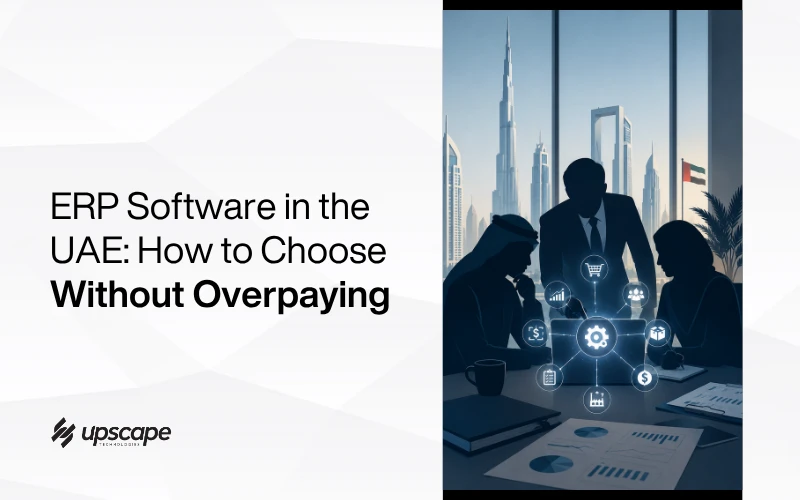

Most ERP selections in the UAE are decided by watching demos. Four vendors present, every system looks capable, and the decision comes down to price or whoever presented most convincingly.
That is roughly like choosing a car by watching adverts.
Here is the number that explains most of what goes wrong afterwards: between 50 and 60 percent of companies never document their ERP requirements before evaluating vendors. Without that, there is nothing objective to compare against, so the process defaults to impressions.
This post covers what to decide before you speak to anyone, how to run demos that actually tell you something, and the cost questions that matter more than the headline price.
Why Most ERP Selections Go Wrong
Demos Are Designed to Impress, Not Inform
A vendor demo shows a clean system, populated with tidy data, performing a workflow the presenter has run a hundred times. Nothing about it is dishonest. It is simply not evidence about your business.
Most selections go wrong because the evaluation runs on polished demos and feature lists, while the questions that predict fit never get asked directly.
Feature Lists Do Not Separate Anything
Ask five ERP vendors whether their system handles inventory, multi-currency and VAT and all five say yes. At that level of detail every system ticks every box.
The differences appear one level down: how much configuration it takes, whether it needs custom development, and whether the workflow matches how you already work or requires you to change.
The UAE Layer Vendors Skip
Two things matter here that generic evaluations miss. Your system has to produce compliant tax invoices with the fields the FTA expects, and it has to cope with however your business is structured across mainland and free zone entities.
Ask about both explicitly. “Yes we support VAT” and “yes we produce a compliant UAE tax invoice” are different claims, and only one of them is useful at filing time.
What Should You Decide Before Talking to Vendors?
Direct answer: your must-haves in writing, your realistic budget across three years, and who internally has to approve the choice.
Separate Must-Have From Nice-to-Have
Write down the workflows the business genuinely cannot operate without. Then, separately, the things that would be pleasant.
This sounds obvious and almost nobody does it. Well-defined criteria turn a subjective, politics-prone decision into a repeatable scoring exercise, and disciplined selection is one of the strongest predictors of an implementation that finishes on time.
Test Against Business Execution, Not Features
The most useful criteria are those tied directly to how work actually gets done. Does the system support your approval structure, your reporting, your cross-functional handoffs, without excessive custom work?
That last clause is the important one. A system that can do anything with enough development can also consume your entire budget getting there.
Decide Who Signs Off
Lack of stakeholder buy-in is a recurring cause of ERP failure, and it usually traces back to people being told about a decision rather than involved in it. If finance, operations and whoever runs your warehouse have not been asked what they need, expect resistance later.
Be Honest About Your Data
Before any vendor sees you, look at your existing records. How many duplicate customers, how many missing tax numbers, how far stock has drifted from reality.
You do not need to fix it yet. You do need to know, because the state of your data affects timeline and cost more than almost any feature decision, and a vendor quoting without seeing it is quoting a fantasy.
The Partner Matters as Much as the Software
This is the part buyers consistently underweight.
The same software implemented by two different firms produces two different results. One maps your processes properly and trains your team. The other configures a default setup and leaves at go-live.
Ask the partner directly: have you implemented this in my industry, in this market, at roughly my size? Who specifically will be on my project? What does your involvement look like eight weeks after go-live? Our post on why ERP implementations fail covers what happens when that last answer is vague.
How Many Vendors Should You Shortlist?
Direct answer: four, maximum.
Why More Becomes Counterproductive
Running demonstrations with more than four vendors gets confusing, particularly for SMEs without a dedicated evaluation team.
Past four, systems blur. You remember impressions rather than specifics, and the decision drifts toward whoever you spoke to most recently. Screen on paper first against your written requirements, then demo the survivors properly.
Score Consistently
Use the same criteria for every vendor, weighted by what actually matters to you. A structured scoring approach across functional fit, technical fit, vendor viability and total cost prevents the loudest opinion in the room from deciding.
It also gives you something defensible to show whoever signs the cheque.
A workable scoring sheet has four columns: does it do this out of the box, does it need configuration, does it need custom development, or can it not do it at all. That distinction alone tells you more about eventual cost than any price list, because the third column is where budgets disappear.
Make Them Demo Your Business
This single change improves the process more than anything else on this list.
Send each shortlisted vendor two or three of your real scenarios in advance. Your quotation process. A stock movement the way it actually happens. An invoice with the fields the FTA expects on a UAE tax invoice.
Then watch them do it live. Not their sample company selling imaginary products, yours.
You learn four things quickly: whether the system genuinely handles it, how many steps it takes, whether it needs customisation, and how well the vendor actually knows their own product.
Count the clicks. A task your team does forty times a day matters enormously if it takes nine steps instead of three, and no feature list captures that. Two-layer evaluation, covering both the platform and the people implementing it, is what separates a fit from a good presentation.
The Cost Questions to Ask Upfront
Year One Is the Wrong Number
Ask for a three-year cost, not a first-year price. Licence or subscription, implementation, customisation, support renewals, and what happens to pricing at renewal.
A low year-one figure with no protection against renewal increases is a common structure and an expensive one.
Ask directly what happens to pricing at renewal and whether increases are capped. A vendor confident in keeping you through good service will answer plainly. One relying on switching costs will not.
Factor In What It Costs You Internally
The invoice is not the whole cost. Your team spends time in discovery workshops, testing, training and running two systems in parallel. That is real time taken from their actual jobs.
Budget for it explicitly rather than assuming people will absorb it, because assuming is how implementations stall waiting on decisions nobody has time to make.
Ask What Is Not Included
Data migration. Training beyond a fixed number of hours. Integrations with tools you already use. Additional users as you grow.
Each of those is a legitimate cost. The problem is discovering them mid-project, when your leverage is gone. Get the list in writing before signing, while you still have alternatives. Our post on ERP data migration explains why that phase in particular gets underestimated.
Open Source Changes the Shape, Not the Total
If you are considering open source options, understand what changes. The licence cost goes to zero. Implementation, customisation and support do not, and those are usually the larger share anyway. Our ERPNext and Odoo comparison covers where that trade genuinely favours you.
The Bottom Line
Write your requirements before you watch a single demo. Shortlist four vendors at most. Make each one perform your actual workflows rather than their showcase. Weight the implementation partner as heavily as the software. Ask for three-year costs.
None of that is complicated. It is simply the work most buyers skip because demos feel like progress and documentation does not.
If you want help defining what you actually need before anyone tries to sell you something, Fadil offers a free consultation with a live demo, and he is happy to have the requirements conversation first without a product pitch attached.
WhatsApp Fadil or call +971 56 544 6259. You can also see the work we have delivered or read what our ERP service covers.
The businesses that overpay for ERP are rarely the ones who negotiated badly. They are the ones who started evaluating before they knew what they needed.