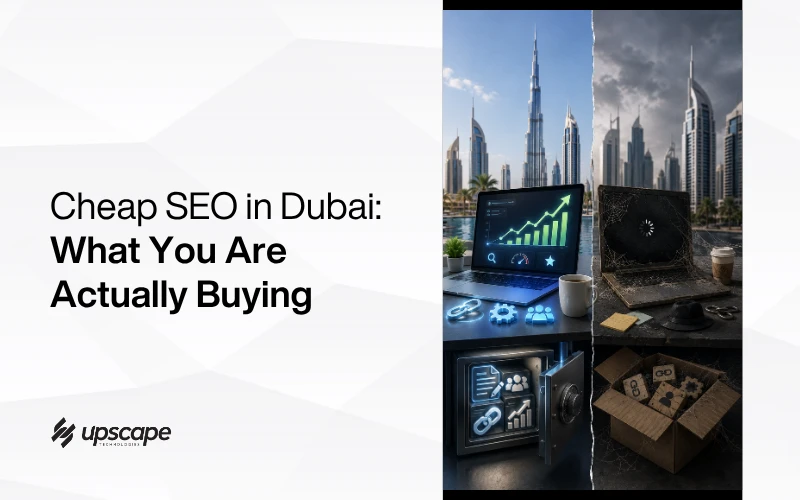

Somebody is offering you SEO for a few hundred dirhams a month, and the pitch sounds reasonable enough.
This post is not an argument that cheap is bad. Plenty of small businesses have genuinely small budgets, and that is a legitimate constraint rather than a failing.
It is arithmetic. Here is what that fee can physically buy, what has to be automated to make the numbers work, and which of those automations carry real risk to a site you already own.
The Arithmetic of a Low Monthly Fee
Work Out the Hours
Take the monthly fee. Subtract what the agency needs for its own overheads. Divide what remains by a realistic hourly rate for skilled work.
A very low monthly package buys well under an hour of actual work, and pricing below a certain floor is simply too low to cover the time legitimate strategic work requires.
An hour a month cannot do keyword research, technical fixes, content production and link building. It can do one of those, badly, or none of them while producing a report.
This is why the deliverables list on a cheap package is always long. A short honest list would reveal how little time is involved, so the list grows to justify the fee while each item shrinks to almost nothing.
So Something Has to Give
This is the part worth understanding. The agency is not necessarily dishonest. They have taken your money at a price that makes real work impossible, so the work becomes automated.
The question is not whether corners are being cut. At that price they must be. The question is which corners, because some are harmless and some are genuinely damaging.
What Gets Automated
Direct answer: content, links and reporting, in roughly that order.
Content Generated in Bulk
Low-cost packages commonly rely on automation for content, including spun or bulk-generated articles. The result reads as filler because it is filler.
This is the least dangerous of the shortcuts. Thin content mostly fails to rank rather than actively harming you, though a site full of it does drag on overall quality signals.
Directory Submissions at Volume
Bulk submissions to hundreds of directories nobody uses. Cheap to automate, easy to show on a report as activity, and worth close to nothing.
Largely harmless, largely pointless. It fills a deliverables list without moving anything.
Worth separating from genuine local citations, which do matter in the UAE. Being listed accurately on directories people actually use is useful. Being submitted to four hundred nobody has heard of is not the same activity.
Links, Which Is Where It Gets Serious
This is the corner that causes real damage.
Cheap services use software to blast links from low-quality sources, and to show progress quickly they acquire volume from irrelevant, spammy sources known as link farms or private blog networks.
Those links are not neutral. They are a pattern search engines specifically look for.
The Link Problem
Why Volume Promises Are the Warning Sign
Promises like “100 backlinks a month” are a significant red flag.
Think about what a genuine link requires: someone deciding your content is worth referencing. That is slow, and it does not happen a hundred times a month for a few hundred dirhams.
When a package promises a specific large number of links, the number itself is the confession. Quality links cannot be produced to a quota.
How to Check What You Are Already Paying For
If you are on a cheap package now, this takes ten minutes. Open Google Search Console, go to the Links report, and look at the sites linking to you.
If you see domains you do not recognise, in languages you do not operate in, on topics unrelated to your business, that is what you have been buying. It is worth knowing before you renew.
What Happens When It Goes Wrong
Sites leaning on low-cost, high-volume link vendors do not merely fail to rank. They get penalised, lose traffic they already had, and spend months or longer recovering.
That is the asymmetry that makes cheap expensive. You are not risking the money you spent. You are risking the visibility you already have, which took far longer to build.
What Happens If It Goes Wrong?
Direct answer: recovery costs considerably more than doing it properly would have.
The Recovery Bill
Recovering from a penalty commonly costs many multiples of what quality SEO would have cost in the first place, before counting the traffic lost while you fix it.
Disavowing bad links, removing thin content, rebuilding trust. Slow, unglamorous, and entirely avoidable.
There is also a practical difficulty. The agency that built those links is rarely the one who helps you remove them, and they may not even be able to tell you where the links came from.
The Cost Nobody Counts
Months of lost enquiries. If your site was producing business and stops, that gap is real money, and no refund covers it.
Worth being clear that not every ranking drop is a penalty. Traffic falls for many reasons, and assuming the worst leads to panicked changes that make things harder to diagnose. Establish what actually happened before acting, which is exactly what a recorded baseline is for. Our guide on running an SEO baseline audit covers what to capture.
Red Flags in the Package Itself
Specific large numbers. “100 backlinks”, “50 blog posts”. Real work is not sold by the unit.
Vagueness about method. If they are secretive about how they work, they are usually hiding something. You are entitled to know what will be published in your name and where links will come from.
Guaranteed rankings. Nobody can promise position one, including Google.
No access requested. If nobody has asked for Search Console access, nobody is measuring anything. Our post on what an SEO consultant should show you in month one covers what should actually happen at the start.
No questions about your business. An agency that never asked what you sell or who buys it is optimising for traffic rather than customers.
What You Can Legitimately Buy on a Small Budget
Direct answer: narrow scope, done properly.
The honest version of affordable SEO is not everything cheaply. It is fewer things done well.
On a genuinely small budget, spend it on: a technical audit with the important fixes actually implemented, proper optimisation of the handful of pages that matter most, a correctly configured Google Business Profile, and a small amount of content written by someone who understands your business.
That is a real, defensible programme. It will not produce results as fast as a larger budget, and it carries no risk of a penalty.
Consider Doing Some of It Yourself
If money is genuinely tight, your own time is the resource you have. Writing a page about your own service, in your own words, is something you can do better than any cheap outsourced writer.
Pay for the parts that need expertise, the technical audit and the strategy, and keep the parts that need knowing your business.
Choosing an affordable package without cutting corners is possible, provided the scope shrinks to match the price rather than the quality shrinking to fit.
If your fundamentals are not in place, that is the first thing worth fixing regardless of budget. Our post on technical SEO mistakes covers what to check, and much of it is free.
The Bottom Line
Cheap SEO is not a scam by definition. It is a maths problem. A low fee buys few hours, few hours force automation, and automated link building is the automation that can genuinely damage a site you already own.
Before signing anything, ask two questions: how many hours a month is this, and where exactly will links come from. Hesitation on either is your answer.
If your budget is small, say so plainly and ask what could be done properly within it. Any agency worth hiring will narrow the scope rather than promise everything.
If you want an honest view of what your budget could realistically achieve, our SEO team in Dubai will tell you straight, including when the answer is that you would be better off spending it elsewhere. We will look at where you actually stand.
WhatsApp Hameed for a quick question, or call +971 56 544 6241 for a free consultation. Either reaches Hameed directly.
The expensive part of cheap SEO is rarely the fee. It is what it costs to undo.