

“Only six pages? That does not sound like enough.”
It is almost always more than enough, and not because a budget forced the decision.
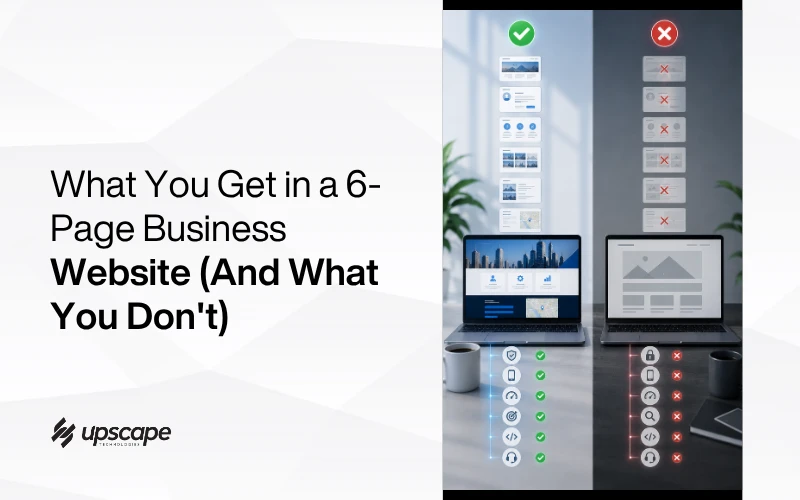
Most small business websites perform well on five to ten core pages, expanding later as the business genuinely needs it. The number is not the constraint people assume it is.
Here is what those six pages should be, where the flexible ones are best spent, and what genuinely sits outside this scope.
The Pages Almost Every Business Needs
Home
The one page every visitor sees. It has to answer what you do, who for, and what to do next, within a few seconds.
Most homepages fail on the first of those. They open with a welcome message or a company history when the visitor is trying to work out whether they are in the right place.
A useful test: show your homepage to someone unfamiliar with your business for five seconds, then ask what you do. Hesitation means the headline is doing the wrong job.
About
More important than it looks, particularly in the UAE where buyers are checking whether you are a real, established business.
Real people, a real address, a trade licence number, how long you have operated. The about page carries trust weight that no amount of design substitutes for.
Contact
Every way to reach you, with the phone number tappable on mobile. A form, and an alternative to the form for people who will not fill one in.
If you have a physical location, a map and genuine opening hours.
In the UAE, WhatsApp belongs here too. A meaningful share of buyers will message rather than call or fill a form, and not offering it costs enquiries you never hear about.
Three Service Pages
This is where the remaining pages should usually go, and it is the decision that matters most.
Where the Sixth Page Should Go
Separate Service Pages Beat One Combined Page
A single page listing five services ranks for nothing in particular. Three pages, each covering one service properly, can each rank for their own search.
A dedicated services or products page structure is one of the essential building blocks of a small business site, and splitting it by service is what turns those pages into entry points rather than a menu.
Each service page should answer what it is, who it suits, roughly what it costs or what determines cost, and what happens next.
Pricing is the one most businesses leave out, and the omission costs them. Visitors who cannot find any indication of cost frequently assume the worst and leave. A range, or an explanation of what drives the number, is enough.
There is a practical limit worth respecting. Splitting one service into four near-identical pages to fill space produces exactly the thin content problem covered below. Split by genuinely distinct services, not by keyword variations of the same one.
When Something Else Earns the Slot
Occasionally a business genuinely needs a different sixth page. Testimonials or case studies if you sell on trust and have real proof. An FAQ if you answer the same five questions on every call.
The right number of pages depends on your goals and industry rather than on a template, and a page earning its place beats a page filling a quota.
How Many Pages Does a Small Business Actually Need?
Direct answer: fewer than you think, and adding more does not add visibility.
More Pages Is Not More Rankings
This is the belief worth dismantling, because it drives a lot of wasted spend.
Publishing more content is no longer a reliable way to grow search visibility. The old model, where quantity compensated for mediocre quality, has changed.
The practical effect on a small site is direct. Ten pages of genuine substance outperform thirty where most were written to fill a sitemap.
Thin Pages Drag on Everything
Thin content is low-value pages that do little for visitors, and the damage is not limited to those pages. Search engines assess sites as a whole.
A relatively small number of pages generate most organic traffic, while a larger number generate almost none and can actively dilute the signals your stronger pages depend on.
A six-page site where every page has a job is a cleaner structure than a twenty-page site where fourteen exist because somebody thought more was better.
What Is Not Included at This Scope
Direct answer: anything with transactions, accounts or a second language.
Ecommerce
Product catalogue, cart, checkout, payment gateway, order management. That is a different build, not extra pages, and it brings ongoing costs. Our post on what an ecommerce website costs to run in Dubai covers those.
If you only need to show products and take enquiries, you may not need checkout at all.
Booking and Member Systems
Appointment booking with calendar sync, customer logins, member areas, quote calculators. Each is custom functionality with its own build and maintenance.
Full Arabic and English
A properly bilingual site is close to two sites: every page translated, right-to-left layout handled, and hreflang configured so search engines serve the right version. Genuinely worth doing for some UAE businesses, and not a six-page project.
A Blog Nobody Will Write
A blog is easy to add. The work is publishing to it consistently.
An abandoned blog whose most recent post is from two years ago actively signals neglect. Either commit to it or leave it out until you do.
What Is Worth Confirming in Writing
Whatever the page count, agree the boundaries before work starts: how many rounds of revisions, who writes the copy, who supplies photography, and what counts as a new page versus a change to an existing one.
Copy is the one that catches people out most often. Many quotes assume you provide the words, and discovering that mid-project is how timelines slip.
Why Starting Small Is Usually Right
Adding a page to a well-built site is straightforward and cheap. Rebuilding a site that was overbuilt at the start is neither.
Starting focused also forces a useful decision: what does this website actually need to accomplish. Businesses that begin with twenty pages rarely answer that, and it shows.
There is a second advantage that only appears later. A small site is quick to keep current. Six pages can be reviewed and updated in an afternoon, which means they actually get updated. Twenty pages get neglected, and out-of-date content does more damage than missing content.
Expanding strategically as the business grows is the sensible path, and it means your later pages get built around what you learned rather than what you guessed.
The Pages People Ask For and Rarely Need
A gallery. Fine if imagery sells your work. Frequently it becomes a folder of photos nobody updates.
A team page at three employees. Put the people on the about page.
A news section for a business that generates no news.
Separate pages per emirate with the location swapped and nothing else changed. That is precisely the thin content that weakens a site rather than extending its reach.
That last one deserves emphasis because it is common advice and bad advice. If you genuinely operate differently in Abu Dhabi, a page about that is legitimate. If it is the Dubai page with one word replaced, search engines recognise the pattern and the site is worse for it.
The Bottom Line
Six pages is not a compromise. Home, about, contact and three properly written service pages covers what most UAE small businesses genuinely need, and does it better than a larger site built to feel substantial.
Spend the pages on the services you sell rather than on sections that exist to look complete. Add more when you have a reason, not in advance of one.
If you want a straight answer on whether six pages fits your business, or whether you genuinely need more, our website design team in Dubai will tell you either way. Our guide on choosing a web design company covers what else to ask before committing. We will scope it honestly.
WhatsApp Hameed for a quick question, or call +971 56 544 6241 for a free consultation. Either reaches Hameed directly.
The best small business websites are not the ones with the most pages. They are the ones where every page earns its place.