
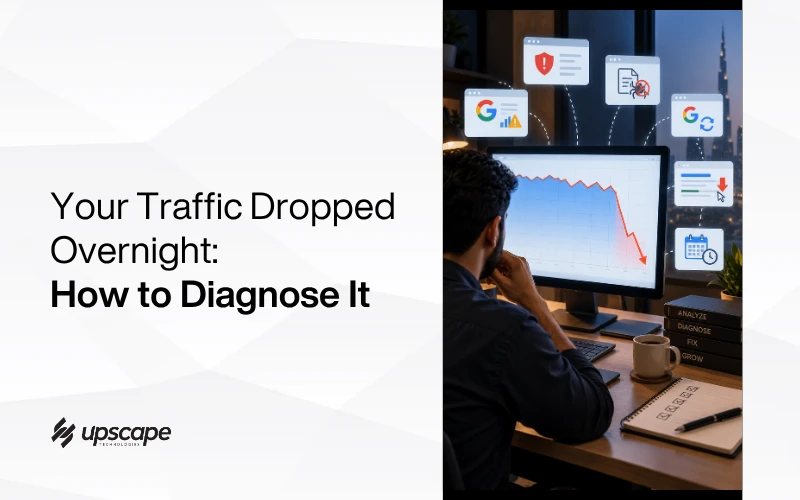

The traffic graph falls off a cliff, and the instinct is immediate: something changed with Google, an algorithm update, a personal penalty, something unfair happening to your site specifically.
Sometimes that is true. More often, the actual cause is one of a handful of specific, checkable things, and Google itself publishes a structured way to work through them. Almost nobody follows it in order, which is usually why the diagnosis takes days instead of minutes.
Here is the actual checklist, in the order that finds the real cause fastest.
Rule Out a Reporting Error First
Sometimes the Drop Is Not Even Real
Before assuming anything happened to your rankings at all, Google’s own guidance points to checking the Data Anomalies page for a change in data processing or a logging error on Google’s side.
This sounds unlikely, and it happens more often than people expect. A drop that looks catastrophic on a graph can occasionally be a reporting artefact rather than a real change in how your site is performing, and checking this first can save an entire afternoon of unnecessary panic.
Check for a Direct Google Action
Manual Actions and Security Issues, First
This is the step worth doing before any deeper investigation, because it removes guesswork entirely. Open Search Console and check the Manual Actions report and the Security Issues report.
If Google has taken direct action, a manual penalty for a specific violation, or a security warning for malware or phishing detected on your site, it appears here explicitly. You are not left inferring anything from a graph. Google tells you directly what happened and, usually, roughly why.
Why This Should Come Before Blaming an Algorithm
A direct manual action or security flag is fixable in a specific, known way: correct the violation, request a review, wait for reconsideration. An assumed algorithm update, by contrast, has no clear fix and no timeline, so confirming or ruling this out first saves considerable wasted effort chasing the wrong cause.
Check for a Technical Problem
The Usual Suspects
Technical causes include an accidental noindex tag, a robots.txt block, a server error during crawl, or a migration that was not handled carefully. These are entirely within your control to have caused, often unintentionally, during an unrelated site update.
How to Check
The Coverage or Indexing report in Search Console shows whether your count of validly indexed pages actually dropped. If it did, something technical changed, a page or section became unreachable or unindexable, rather than the ranking of pages that are still perfectly indexed.
This distinction matters enormously for where you look next. A falling indexed count points at your own site’s configuration. A stable indexed count with falling traffic points somewhere else entirely.
Was It Actually an Algorithm Update?
This Should Be Checked, Not Assumed
Genuine algorithmic updates are broad and affect many sites simultaneously, not one site in isolation. Google’s guidance suggests checking whether the drop lines up with a known update, and comparing against a longer historical window rather than assuming any unexplained drop must be one.
If your drop is isolated to your site while comparable sites in your space show no similar pattern, an algorithm update becomes considerably less likely as the explanation, and the earlier technical checks deserve another look.
Impressions Steady, Clicks Falling: A Different Problem Entirely
This Is Not a Ranking Issue
If impressions remain roughly the same while clicks fall, the likely cause is your title and snippet, not your position. You are still being shown for the same searches. People are simply choosing not to click through anymore.
What Usually Causes This
A title that stopped accurately describing the page, a competitor’s result becoming more compelling, or in some cases a rich result or AI-generated summary above your listing absorbing the click before anyone reaches your result at all. This distinction changes the entire fix: rewriting a title and description is a very different task from a technical or ranking recovery effort.
Rule Out Ordinary Seasonality
Pull a Longer History Before Concluding Anything
Google’s own advice is to check the last 16 months of data specifically to rule out a drop that happens every year. A business with genuinely seasonal demand, tied to a UAE school calendar, a religious observance, or a tourism cycle, sees a real, recurring dip that has nothing to do with anything Google changed.
Comparing only against last month, rather than the same period a year earlier, is the single most common reason seasonal businesses panic unnecessarily over a pattern that repeats annually.
How to Actually Run This Diagnosis
Find Exactly When It Started
Open the Performance report, find the point where the graph actually bends downward, and narrow the date range to that specific window. A vague sense of “traffic has been down lately” is much harder to diagnose than an exact date range.
Check Whether It Hit the Whole Site or One Section
Reviewing the Pages table shows whether the drop happened site-wide, across one group of pages, or on a single important page. A drop isolated to one page points at something specific to that page. A drop across the entire site points at something structural or algorithmic.
Confirm Whether It Is Just You
Checking the relevant search terms on Google Trends shows whether interest fell across the web generally or specifically for your site. If overall search interest for your topic collapsed, that is a demand problem, not an SEO problem, and no technical fix addresses it.
The Bottom Line
A sudden traffic drop has a genuine, structured way to diagnose it, and Google publishes the order to check things in. Rule out a reporting error, check for a direct action against your site, check for a technical fault, only then consider an algorithm update, check whether it is really a click-through problem instead of a ranking one, and rule out seasonality with real historical data.
Most panicked traffic-drop discussions skip straight to blaming the algorithm. That is genuinely the last thing worth checking, not the first, and working through the earlier steps usually finds the real, fixable cause faster.
If your traffic has dropped and you would rather have someone run this diagnosis properly than guess, our SEO services for Dubai businesses start with exactly this kind of investigation.
WhatsApp Hameed for a quick question, or call +971 56 544 6241 for a free consultation.
A falling graph is a symptom. The six checks above are how you find out what it is actually a symptom of.