
Most UAE businesses run HR across three or four tools that do not talk to each other. A spreadsheet tracking leave balances nobody trusts. WhatsApp messages settling attendance disputes. A separate payroll provider who has no idea someone took unpaid leave last month until the numbers come back wrong.
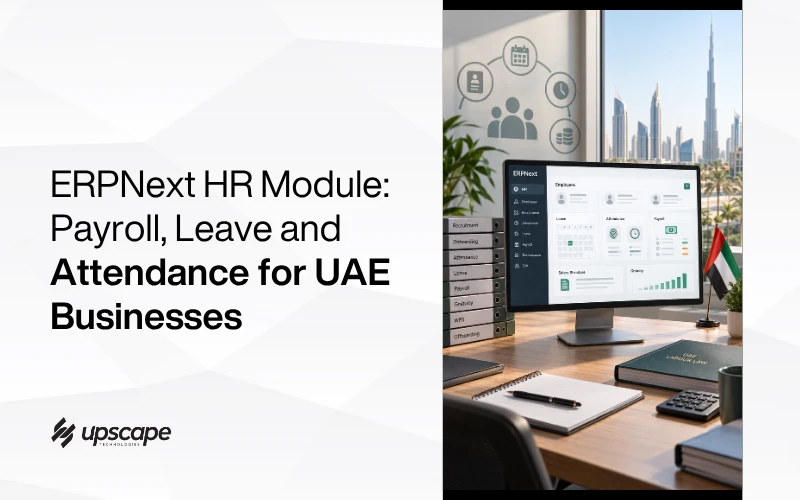
ERPNext’s HR system, technically its own open source app called Frappe HR since version 14, handles the entire employee lifecycle in one connected place. Here is what genuinely works out of the box, and what UAE businesses specifically need to configure rather than assume.
It Is Its Own App Now, Not a Core Module
The Version 14 Split
Since ERPNext version 14, the entire HR and payroll suite moved out of the core system into Frappe HR, a standalone, fully open source application maintained by Frappe with no paid tier attached to it.
This matters practically because it means HR functionality is actively maintained as its own dedicated product, with focused development, rather than a secondary feature bolted onto general ERP functionality.
The Full Employee Lifecycle, Connected
The system covers recruitment, onboarding, attendance, leave, payroll, taxation and exit as one connected flow rather than separate disconnected stages, which is precisely the gap most spreadsheet-and-WhatsApp setups never close.
What Genuinely Works Out of the Box
Leave and Attendance
Leave policies can be configured per employee type, regional holiday calendars can be pulled in with a click, and attendance is tracked through check-in and check-out including geolocation capture. Leave balances and attendance reports are available without additional configuration beyond the initial policy setup.
Salary Structures Built Once, Reused Every Month
Salary structures are created once per role or employee category and reused for every payroll run afterward, rather than rebuilt manually each month. Income breakdowns, additional payments, and off-cycle payments are all supported within the same structure.
Leave and Attendance Actually Feed Payroll
This is the part that quietly saves the most manual correction work. Leave without pay and attendance-based working days flow directly into the payroll calculation, so an employee who took unpaid leave has that automatically reflected in their salary run rather than someone manually adjusting a number after the fact.
What Is Not a Built-In Checkbox
Direct answer: UAE-specific compliance, and this is worth being genuinely honest about rather than overselling.
Gratuity and WPS Are Configuration, Not a Switch
The core Frappe HR documentation does not describe UAE gratuity calculation or WPS-format salary file generation as a native, pre-built feature. What the system does provide is flexible salary structures and components capable of being configured to calculate gratuity correctly and produce compliant output, which is a genuinely different thing from a single toggle that “just works.”
Frappe maintains a separate regional app specifically for UAE customisations, covering region-specific fields, print formats and reports, and payroll teams commonly generate WPS-format files and provision gratuity through properly configured salary components built during implementation.
This Is Not a Weakness, It Is How HR Systems Actually Work
Every serious HR platform, not only this one, separates its general framework from local statutory compliance, because labour law genuinely differs by country and changes over time. A system claiming UAE gratuity works automatically out of the box, on any platform, is skipping the part where someone actually configured it correctly against current UAE labour law.
The honest version: the framework is genuinely comprehensive and well built. The UAE compliance layer, gratuity calculated correctly, WPS files in the right format, is exactly the part that needs a deliberate, competent implementation rather than a default install.
Why This Distinction Matters When Evaluating ERPNext for HR
It Changes What You Should Actually Ask an Implementation Partner
Rather than asking whether ERPNext “does UAE payroll,” the more useful question is how a specific partner configures gratuity calculation and WPS output, and whether they have done it correctly before. That is where implementation quality genuinely shows, not in whether the base software exists.
It Also Explains Why Cheap, Rushed Implementations Fail Quietly
This is the same pattern behind most disappointing ERP projects generally. Our post on why ERPNext implementations fail covers the wider version of it, and payroll is where the pattern bites hardest, because a misconfigured salary structure is not a cosmetic problem. It is wrong money in someone’s account, discovered by the employee rather than by you.
Payroll also has an unforgiving deadline. A stock module you can grow into over a quarter is one thing. A payroll run happens on a fixed date whether the configuration is finished or not.
A rollout that installs the base system and never properly configures the UAE-specific salary components can look functional for months, right up until an employee’s end-of-service settlement is calculated incorrectly. This is a compliance risk that does not announce itself until it becomes an expensive, specific problem.
A Practical Way to Evaluate This
Ask to See a Configured Salary Slip, Not Just a Demo Login
A generic demo environment shows the framework working. It rarely shows a real UAE salary structure with gratuity provisioning already configured. Ask a prospective implementation partner to walk through an actual configured example, including how a resignation and an end-of-service settlement would calculate, before assuming the platform handles it automatically.
Multi-Company and Group Structures Benefit Most
For a UAE group with several related entities on one payroll cycle, ERPNext’s structure supports managing multiple companies within one system, which matters for HR specifically when staff or contracts move between related entities and need continuous, correctly calculated service records rather than starting fresh each time.
The Bottom Line
ERPNext’s HR module, as Frappe HR, is a genuinely comprehensive open source system covering the full employee lifecycle, with leave, attendance and core payroll working well out of the box. UAE-specific requirements, gratuity and WPS compliance particularly, are handled through the system’s flexibility rather than a native switch, and that configuration work is exactly where a competent implementation partner earns their fee.
If you are evaluating ERPNext for HR and want an honest answer about what your specific UAE payroll setup would actually require, our ERP services team can walk through it properly before you commit to anything.
WhatsApp Fadil or call +971 56 544 6259 for a free consultation with a live demo.
Software that claims UAE compliance works automatically is usually the software that has not been asked the right question yet.