
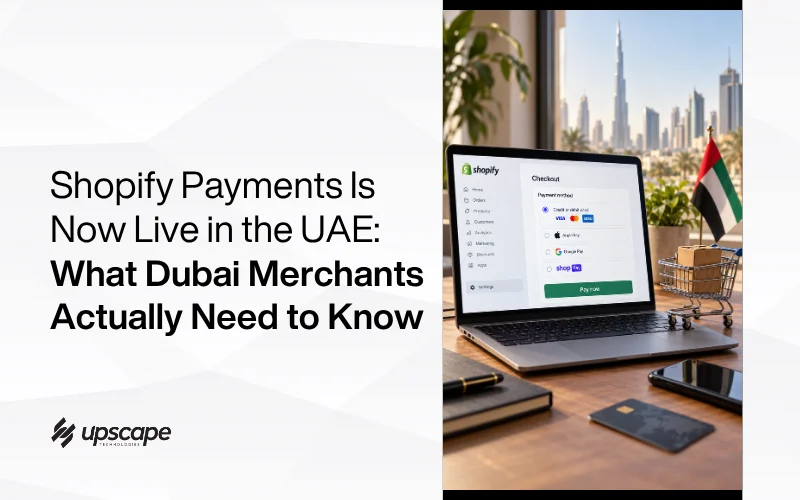

For years, the honest answer to “can I use Shopify Payments in the UAE” was a flat no. That changed in 2026, and a lot of Dubai store owners still haven’t caught up with what actually shifted.
What Actually Changed, and When
A Genuine, Recent Rollout
Shopify Payments went live for UAE merchants in 2026, initially limited to stores on the Plus plan. Shopify Payments in the United Arab Emirates expanded to the Advanced plan on August 26, 2026, according to Shopify’s own official changelog.
Still Early Access, Not a Full Public Launch
This remains explicitly framed by Shopify as an early access rollout, available only to certain merchants rather than every UAE store. Shopify’s own announcement makes no mention of a confirmed date for extending access to the Basic or Standard plans, which is where a large share of smaller UAE merchants actually operate.
What’s Genuinely Supported for Eligible Stores
Card Payments and Accelerated Checkout
For stores on the Advanced or Plus plan, Shopify Payments in the UAE supports credit and debit card payments plus accelerated checkout options, including digital wallets like Apple Pay, Google Pay, and Shop Pay, with 3D Secure authentication for fraud protection.
Payouts Land Directly in AED
Merchants using Shopify Payments in the UAE receive payouts in AED on all eligible subscription plans, removing the currency conversion step that a third-party international gateway often adds.
An Important Limitation Even for Eligible Stores
Shopify Payments in the UAE is currently limited to online selling. A store also running an in-person point-of-sale setup still needs a separate solution for those transactions, since native POS payment processing isn’t part of this rollout yet.
What This Means for Your Specific Store
If You’re on Basic or Standard
Nothing has changed for you yet. You still need a third-party payment gateway that supports AED, with Checkout.com and PayTabs among the most established options that integrate directly with Shopify for UAE merchants. Setting one of these up remains the correct move today, not a workaround waiting to be replaced.
If You’re on Advanced or Plus
You have a genuine decision to make: switching to native Shopify Payments removes a third-party integration from your stack entirely, simplifying reconciliation and support to a single vendor. This is worth evaluating even for a store that already has a working third-party gateway in place, since consolidating onto Shopify’s own processing reduces the number of moving parts a store depends on.
Buy Now, Pay Later Still Needs Its Own Setup
Regardless of Shopify Payments eligibility, popular UAE BNPL providers like Tabby and Tamara require their own dedicated Shopify apps, since these aren’t bundled into Shopify Payments itself. Given that integrating either typically increases average order value by 20 to 35 percent for UAE stores, this is worth setting up separately regardless of which payment path a store takes.
What This Changes About Running a UAE Store
One Vendor Instead of Two, If You Qualify
The practical gain from native Shopify Payments is not lower fees, which vary case by case. It is fewer moving parts. Payments, orders and payouts sit inside one system with one support channel, so a failed transaction is a single conversation rather than an argument between a gateway and a platform about whose problem it is.
That simplification is worth real money in staff time for a small team, and it removes a category of outage where the store works but checkout quietly does not.
It Does Not Remove the Rest of the Checkout Work
Payments processing is one component of whether a UAE customer completes an order. Currency display, locally trusted payment options and a checkout that does not demand unnecessary information all sit alongside it, and native processing improves none of them on its own.
Worth reading in that context: what an ecommerce website actually costs to run in Dubai covers the ongoing costs that a payment decision sits inside rather than replaces.
Don’t Assume Either Way, Check Directly
The Fastest Way to Confirm Your Status
Inside the Shopify admin, under Settings and then Payments, a store either sees Shopify Payments as an available option to activate, or doesn’t. This is the definitive check, rather than assuming based on general news that access has or hasn’t arrived for a specific plan tier.
A Fast-Moving Rollout Worth Rechecking Periodically
Given the phased nature of this rollout, a store currently ineligible on Basic or Standard is worth rechecking every few months as Shopify continues expanding access, rather than assuming the current limitation is permanent.
The Bottom Line
Shopify Payments genuinely works in the UAE now, for the first time, but only for stores on the Advanced or Plus plans, and only for online transactions so far. Most small Dubai merchants on Basic or Standard still need a third-party gateway like Checkout.com or PayTabs today, exactly as before this rollout began.
Check your actual plan and eligibility directly in your Shopify admin before assuming either that nothing has changed, or that you already have access you don’t.
If you want help setting up payments correctly for your specific plan, whether that’s native Shopify Payments or the right third-party gateway, our website design team can walk through what fits your store.
WhatsApp Hameed for a quick question, or call +971 56 544 6241 for a free consultation.
A rollout most Dubai merchants haven’t noticed yet is still a rollout. Check your plan before assuming the old answer still applies.