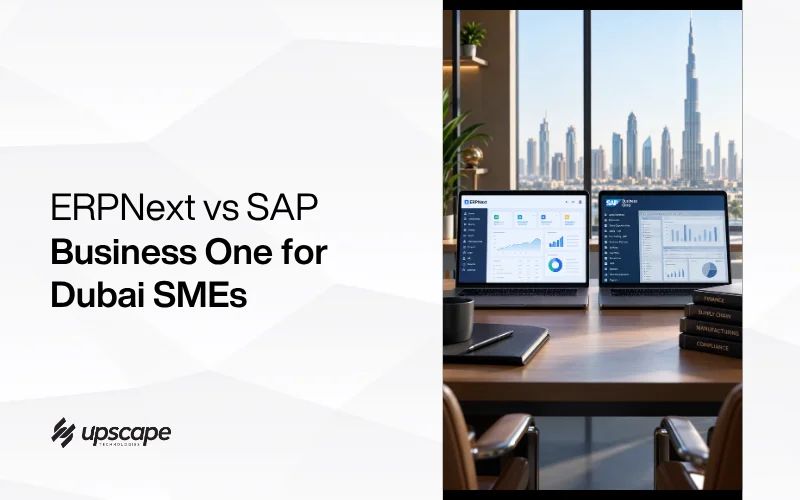

“Should we go with SAP or ERPNext?” It’s one of the first questions almost every Dubai SME asks once they decide to move off spreadsheets and disconnected tools. Here’s an honest comparison of both, not a pitch for either.
The Cost Gap Is the First Thing to Understand
What Each One Actually Costs
ERPNext’s typical total cost runs $0 to $30,000, while SAP Business One typically runs $50,000 to $250,000. SAP Business One licensing starts around $95 per user per month, while ERPNext’s core software is free and open source, with costs concentrated in implementation, customisation, and ongoing support rather than per-seat licensing.
Why Unlimited Users Matters More Than It Sounds
ERPNext allows unlimited users without additional software licence fees, which matters more in practice than the headline number suggests. A growing Dubai SME hiring five new staff members doesn’t automatically see its ERP bill jump the way it would under a strict per-seat licensing model, which is exactly how SAP Business One and most traditional ERP platforms are priced.
Implementation Timeline
A Meaningfully Different Speed to Value
ERPNext implementations typically take 1 to 3 months, while SAP Business One implementations typically take 3 to 6 months. Part of this gap reflects SAP Business One’s more complex licensing and configuration process, and part reflects the broader scope typically involved in a SAP-grade rollout.
For a business that needs to be operational quickly, that difference in timeline is a real, practical factor, not just a cost consideration.
Where SAP Business One Genuinely Earns Its Price
Decades of Enterprise-Grade Depth
SAP Business One brings decades of established enterprise financial and manufacturing functionality, a large global partner and integration ecosystem, and brand recognition that carries genuine weight with certain investors, banks, and larger enterprise clients who specifically expect to see it.
When This Actually Matters
This advantage is real, but it’s specifically valuable at a certain scale and complexity, not universally. A business genuinely operating with the financial or manufacturing complexity that SAP’s deeper enterprise features were built for gets real value from that depth. A smaller SME paying SAP’s price without actually using that depth is paying for capability it isn’t drawing on.
Where ERPNext Genuinely Earns Its Case
Total Cost of Ownership, Not Just Sticker Price
ERPNext offers a more accessible pricing model with lower entry costs and significant ROI through cost savings and scalability, covering the same core functional ground, accounting, inventory, HR, CRM, projects, and manufacturing, that most SMEs actually need day to day.
Open Source Means No Vendor Lock-In
Because ERPNext is open source, a business isn’t tied indefinitely to one vendor’s pricing decisions, roadmap priorities, or licensing changes down the line. This matters over a multi-year horizon in ways that aren’t always obvious at the point of initial selection, when both platforms look similarly capable on paper.
Faster Time to Actually Using It
The shorter typical implementation window means a business reaches genuine day-to-day usage sooner, which also means less time spent running parallel systems or manual workarounds during a longer transition period.
Matching the Choice to Actual Business Size
Most Dubai SMEs Fit ERPNext’s Sweet Spot
Both platforms are typically chosen by organisations in the 1 to 250 employee range, which covers the overwhelming majority of Dubai’s SME market. For a business in this range without a specific enterprise-grade requirement already identified, ERPNext covers the same practical ground at a fraction of both the upfront and ongoing cost.
The Honest Question to Ask First
Before comparing feature lists, the more useful question is whether your business has a specific, identified need for SAP-grade depth, a particular financial complexity, a manufacturing process, or an investor or client requirement that genuinely calls for it. If rollout stalls or adoption problems are the bigger risk to your business right now, a faster, lower-cost implementation reduces that risk more than extra enterprise depth you aren’t yet using would.
What to Actually Compare in a Demo
Ask Both Vendors the Same Awkward Question
Feature lists rarely decide this well, because both platforms will tick most boxes on paper. A more revealing question: show me this exact process, with my numbers, end to end. Pick the workflow your business runs most often, whether that is a quotation turning into an invoice or a purchase order flowing into stock, and ask each vendor to demonstrate precisely that.
Differences that matter appear immediately under that kind of scrutiny. How many clicks the routine job takes. Whether your reporting exists as standard or needs building. Whether the person demonstrating can answer questions about your industry without deferring.
Count the Costs That Are Not Licensing
Whichever platform you choose, the licence is rarely the largest line item over three years. Implementation, data migration, training, support and eventual customisation usually exceed it. Our guide on choosing ERP software in the UAE without overpaying breaks down where those costs actually accumulate, and it applies equally to both options here.
The Bottom Line
SAP Business One and ERPNext both genuinely work, but they’re built for different points on the cost and complexity spectrum. For most Dubai SMEs in the SME range, ERPNext delivers the same core functionality at a meaningfully lower total cost and a faster path to actually running on the system. SAP Business One earns its price once a business is operating at the scale or complexity where its specific enterprise depth is genuinely being used.
If you want an honest read on which fits your actual business, not a sales pitch toward either, our ERP Solutions team can walk through your specific requirements with a live demo.
WhatsApp Fadil or call +971 56 544 6259 for a free consultation.
The right ERP isn’t the one with the biggest name. It’s the one that matches the complexity you actually have, not the complexity you might have someday.