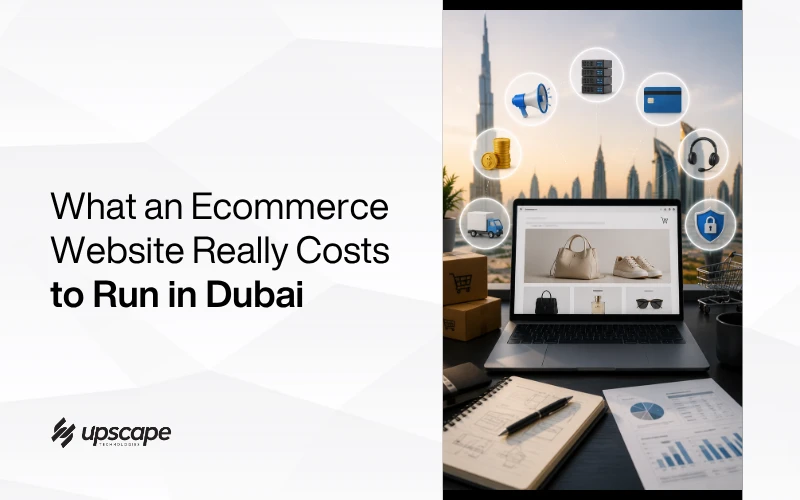

Every quote you receive is for building the store. Almost none of them tell you what it costs to keep running.
That gap is why so many Dubai online stores launch looking excellent and quietly stop making commercial sense within a year. The build was affordable. The running was not, and nobody had done that arithmetic before signing.
Here is what actually leaves your account each month, including the two costs specific to trading in the UAE that most quotes never mention.
Build Cost Is the Part Everyone Quotes
The Range Is Enormous
That spread is real and mostly reflects how much is custom. A themed Shopify store and a bespoke platform are different products, and both are legitimate purchases depending on what you are selling.
Why It Distracts You
The build is a one-off. The running cost repeats every month for as long as the business exists, and over three years it usually exceeds what you paid to build.
Deciding on build price alone is like choosing a vehicle on sticker price without asking about fuel.
What Are the Ongoing Costs?
Direct answer: hosting, platform fees, maintenance, apps, and gateway charges. The last of those is usually the biggest and the least examined.
Hosting and Platform
Hosting spans roughly $5 to $250 per month depending on what you are running, and managed hosting in this market commonly falls between AED 1,500 and 5,000 annually.
If you are on a hosted platform, the subscription replaces hosting. If you are on WooCommerce or something custom, hosting is yours to manage and its cost tracks your traffic.
Hosting location matters here beyond the price, since a server far from your customers slows the store for the people most likely to buy from it. We covered why hosting location affects UAE site speed in the context of redesigns, and the same physics applies to a storefront.
Maintenance and Support
Dubai agencies commonly charge in the region of AED 2,500 to 7,500 per month for support and maintenance on a serious store.
You can spend less. What you cannot do is spend nothing, because an unmaintained store accumulates broken checkouts, failed updates and security problems. The cost of neglect arrives as lost orders rather than an invoice, which makes it easy to ignore until it is expensive.
Apps and Plugins
These multiply quietly. A subscription for reviews, another for abandoned carts, another for shipping rates, another for reporting. Individually trivial, collectively a real monthly number.
Audit them twice a year. Most stores are paying for at least one thing nobody uses.
Domain, SSL and Email
Small individually, and easy to forget until something expires. A domain renewal, an SSL certificate if it is not bundled, and business email hosting.
The failure mode here is not cost, it is lapse. An expired domain or certificate takes the store offline, and it always happens at a weekend. Set them to auto-renew and check the card on file has not expired.
Photography and Content
Rarely in any quote, and continuous. New products need photographs and descriptions, and somebody has to produce them.
For a store adding stock regularly this is one of the larger real costs of operating, and it is almost always underestimated because it does not arrive as an invoice from a supplier.
Payment Gateway Fees in the UAE
This is the cost that decides whether thin-margin products work at all.
The Rates
Typical gateway rates in this market run around 2.4 to 2.9 percent per transaction plus a small fixed fee. Confirm the exact rate with your provider before committing, since it varies by volume and by the mix of cards you take.
Do the arithmetic on your own numbers before choosing a platform. A store turning over AED 100,000 monthly at 2.7 percent is paying about AED 2,700 in transaction fees alone, every month, before anything else.
The Shopify Complication
Shopify Payments is not fully available in the UAE, so most merchants here use PayTabs, Telr or Stripe. When you use an external gateway, Shopify adds its own transaction fee on top of the gateway’s charge.
You are then paying twice on the same sale. It is not hidden, it is in their pricing, but it routinely surprises UAE merchants who compared platform subscriptions and assumed that was the comparison.
What This Means for Your Margin
If you sell high-margin products, gateway fees are an annoyance. If you sell anything with thin margins, they are a structural part of your P&L and should influence which platform you choose.
VAT and FTA Compliant Invoicing
Direct answer: your store must charge 5 percent correctly and issue compliant tax invoices, and that is configuration work rather than a setting you switch on.
What Compliance Actually Requires
UAE stores must handle 5 percent VAT correctly and generate FTA compliant tax invoices, with the invoice logic and reporting work commonly costing in the AED 2,000 to 6,000 range to set up properly.
Getting this wrong is not a cosmetic problem. Invoices that do not meet requirements create difficulties for your business customers and for you at filing time.
Budget It Into the Build
The mistake is treating VAT as something to sort out after launch. Retrofitting compliant invoicing onto a live store with existing orders is more work than building it in, and it usually happens under time pressure.
If your store is going to feed into an accounting or inventory system, decide that before launch too. Connecting a storefront to a back office afterwards is a project in itself, and ERPNext handles the ecommerce connection if you eventually need stock and orders in one place rather than reconciling two systems by hand.
The Licence Nobody Mentions
You need an e-commerce licence to trade online in the UAE, and it typically runs in the region of AED 6,500 to 15,000 for a properly set up store.
This sits outside anything a web agency quotes, because it is not their service. It is still money you must spend before the store can legally operate, and it renews.
If you are still deciding whether you need full checkout at all, that decision affects this directly. Some businesses are better served by a catalogue site that drives enquiries, which avoids gateway fees and much of the compliance work entirely.
Delivery: The Cost That Decides Your Pricing
Shipping is not a website cost, but it is the running cost that most often makes an otherwise sensible store unprofitable.
Within Dubai, same-day and next-day delivery are effectively expected. Across emirates the cost rises. Free delivery over a threshold is common precisely because it pushes basket sizes above the point where the delivery cost stops hurting.
Work out your delivery cost per order and set that threshold deliberately, rather than copying whatever a competitor displays. Fulfilment is one of the parts nobody quotes and it belongs in the model from day one.
Returns matter too. A returned item costs you delivery both ways plus handling, and in some categories the return rate is high enough to change which products are worth listing.
A Realistic Monthly Running Total
For a modest but properly run UAE store, expect a monthly picture roughly like this: hosting or platform subscription, maintenance in the low thousands of dirhams, app subscriptions, and gateway fees scaling with your revenue.
A serious UAE commerce operation commonly runs somewhere between AED 1,500 and 7,500 per month before marketing. Where you land inside that depends mostly on how much support you buy and how much you sell.
Add your licence renewal annually, and your VAT compliance work at the start.
Build costs across the UAE market vary enormously by platform, but running costs converge far more than build costs do. Two stores built for wildly different amounts often cost something similar to operate, which is another reason the build quote tells you so little.
Where the Money Actually Goes
For most small UAE stores the ranking is consistent: gateway fees first once you have real volume, then support and maintenance, then platform and hosting, then apps.
That ordering matters because it is the reverse of where attention usually goes. Businesses agonise over a hosting plan costing a few hundred dirhams a year while accepting a gateway rate that costs them thousands.
If you are unsure whether your existing store is earning its running costs, the questions in our diagnostic checklist for underperforming websites apply directly.
The Bottom Line
The build price is the least important number in the conversation, and it is the only one most quotes contain.
Before approving anything, work out your monthly total including gateway fees at your expected volume. Then decide whether the store still makes sense. Sometimes it does not, and a catalogue site with strong enquiry handling is the better business.
If you want a straight answer on what your store would cost to run rather than just to build, our website design team in Dubai will give you the monthly figure alongside the quote. We will also tell you if you do not need full ecommerce. We are happy to work the numbers through with you.
WhatsApp Hameed for a quick question, or call +971 56 544 6241 for a free consultation. Either reaches Hameed directly.
A store that is cheap to build and expensive to run is not a bargain. It is a bill on a delay.